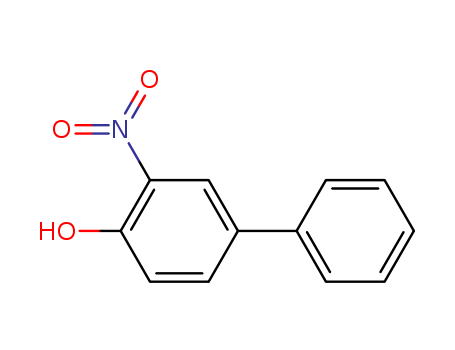
Quality products?make an important contribution to long-term revenue and profitability. Cost-effective and customizable 4-HYDROXY-3-NITROBIPHENYL 885-82-5 supplier
1.What is the 4-HYDROXY-3-NITROBIPHENYL ?
Used in Chemical Synthesis:
4-HYDROXY-3-NITROBIPHENYL is used as an intermediate in the synthesis of various organic compounds. Its unique structure with a hydroxyl and nitro group allows for further chemical reactions and modifications, making it a valuable component in the production of different chemical products.
Used in Research and Development:
Due to its mutagenicity and carcinogenic properties, 4-HYDROXY-3-NITROBIPHENYL is utilized in research and development for studying the effects of these properties on biological systems. This helps in understanding the mechanisms of mutagenicity and carcinogenicity, which can contribute to the development of safer chemicals and compounds.
Used in Environmental Monitoring:
4-HYDROXY-3-NITROBIPHENYL can be used as a reference compound in environmental monitoring studies to assess the presence of mutagens and carcinogens in the environment. Its known properties can help in identifying and quantifying similar compounds, providing valuable information for environmental protection and risk assessment.
Used in Safety Training and Education:
Given its potential health hazards, 4-HYDROXY-3-NITROBIPHENYL can be used as a case study in safety training and education programs for laboratory and industrial workers. This helps in raising awareness about the risks associated with handling hazardous chemicals and emphasizes the importance of proper safety precautions and procedures.
-

-
92-69-3
4-Phenylphenol

-
-
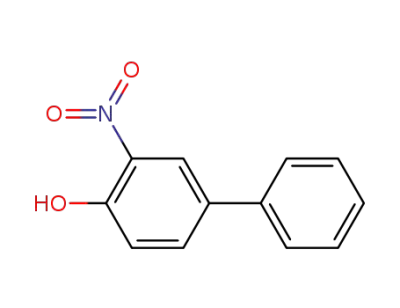
885-82-5
4-phenyl-2-nitrophenol
| Conditions | Yield |
|---|---|
|
With
tetrachlorosilane; silica gel; sodium nitrite;
In
dichloromethane;
at 20 ℃;
for 2h;
|
99%
|
|
With
silica gel; citric acid; sodium nitrite;
In
hexane;
at 20 ℃;
for 3h;
|
99%
|
|
With
nitric acid;
In
acetic acid;
|
99%
|
|
With
dimethylbromosulphonium bromide; tetrabutylammonium nitrite;
In
acetonitrile;
at 20 ℃;
for 1.5h;
regioselective reaction;
|
96%
|
|
With
sodium hydrogen sulfate; silica gel; sodium nitrite;
In
dichloromethane;
at 20 ℃;
for 3h;
|
95%
|
|
With
sodium nitrate;
In
neat (no solvent);
at 20 ℃;
for 0.5h;
Green chemistry;
|
94%
|
|
With
bismuth (III) nitrate pentahydrate;
In
acetone;
at 20 ℃;
for 2h;
Reagent/catalyst;
|
93%
|
|
With
sodium nitrate; sodium hydrogen sulfate; silica gel;
In
dichloromethane;
at 20 ℃;
for 3h;
|
92%
|
|
With
nitric acid;
In
acetic acid;
|
91%
|
|
With
poly(ethylene glycol)-N2O4;
In
dichloromethane;
at 20 ℃;
for 0.416667h;
|
90%
|
|
With
trichloroisocyanuric acid; bismuth subnitrate/charcoal;
In
dichloromethane;
at 20 ℃;
for 2h;
regioselective reaction;
|
90%
|
|
With
tetrabutylammonium chromate; sodium nitrite;
In
dichloromethane;
for 69h;
chemoselective reaction;
Reflux;
|
90%
|
|
With
Oxone; silica gel; sodium nitrite;
In
dichloromethane;
at 20 ℃;
for 2h;
|
88%
|
|
With
silica-OSO3H; silica gel; sodium nitrite;
In
dichloromethane;
at 20 ℃;
for 2h;
|
86%
|
|
With
nitric acid; acetic acid;
In
chloroform;
for 1.5h;
Ambient temperature;
|
85%
|
|
With
1,3,5-tribromo-1,3,5-triazinane-2,4,6-trione; silica gel; sodium nitrite;
In
dichloromethane;
at 20 ℃;
for 1h;
|
80%
|
|
With
melamine-(H2SO4)3; C3H6N6*3HNO3;
In
neat (no solvent);
Green chemistry;
|
79%
|
|
With
trichloroisocyanuric acid; silica gel; sodium nitrite;
In
dichloromethane;
at 20 ℃;
for 0.333333h;
|
74%
|
|
With
ammonium nitrate; silica gel;
In
chloroform; water;
for 12h;
Reflux;
|
70%
|
|
With
nitrourea; silica-gel-supported sulfuric acid;
In
dichloromethane;
at 20 ℃;
for 1.83333h;
regioselective reaction;
|
63%
|
|
With
aluminium trinitrate;
In
acetonitrile;
at 0 - 23 ℃;
regioselective reaction;
|
57%
|
|
With
silica sulfuric acid; guanidine nitrate; silica gel;
In
dichloromethane;
at 20 ℃;
for 0.416667h;
|
54%
|
|
With
aluminum(III) nitrate nonahydrate; sulfuric acid; silica gel; silica gel;
In
dichloromethane;
at 20 ℃;
for 0.333333h;
|
52%
|
|
With
poly(4-vinylpyridinium nitrate); silica supported sulfuric acid;
In
dichloromethane;
at 20 ℃;
for 0.166667h;
|
48%
|
|
With
nitric acid; acetic acid;
|
|
|
With
dihydrogen peroxide; acetic acid; sodium nitrite;
|
|
|
With
nitric acid;
In
nitromethane;
|
|
|
With
nitric acid;
In
chloroform;
at 0 ℃;
|
|
|
With
tetrabutylammomium bromide; nitric acid;
In
diethyl ether; water;
at 20 ℃;
for 5h;
regioselective reaction;
|
96 %Chromat.
|
|
Multi-step reaction
with
3
steps
1.1: potassium phosphate; 2-Picolinic acid; copper(l) iodide / dimethyl sulfoxide / 24 h / 90 °C / Inert atmosphere
2.1: silver(I) nitrite; palladium dichloride; dipotassium peroxodisulfate / 1,2-dichloro-ethane / 50 h / 110 °C / Sealed tube
3.1: methyl trifluoromethanesulfonate / toluene / 2 h / 90 °C / Inert atmosphere
3.2: 0.5 h / 80 °C / Inert atmosphere
With
2-Picolinic acid; potassium phosphate; dipotassium peroxodisulfate; copper(l) iodide; silver(I) nitrite; methyl trifluoromethanesulfonate; palladium dichloride;
In
dimethyl sulfoxide; 1,2-dichloro-ethane; toluene;
|
|
|
Multi-step reaction
with
3
steps
1.1: potassium phosphate; 2-Picolinic acid; copper(l) iodide / dimethyl sulfoxide / 10 h / 90 °C / Inert atmosphere
2.1: palladium diacetate; tert.-butylnitrite / 1,2-dichloro-ethane / 30 h / 80 °C / Sealed tube
3.1: methyl trifluoromethanesulfonate / toluene / 2 h / 90 °C / Inert atmosphere
3.2: 0.5 h / 80 °C / Inert atmosphere
With
2-Picolinic acid; potassium phosphate; copper(l) iodide; tert.-butylnitrite; palladium diacetate; methyl trifluoromethanesulfonate;
In
dimethyl sulfoxide; 1,2-dichloro-ethane; toluene;
|
|
|
With
nitric acid;
In
toluene;
at 70 ℃;
for 1h;
|
-
![2-((3-nitro-[1,1'-biphenyl]-4-yl)oxy)pyridine](/upload/2026/5/a25e284efed44fb8ada8659461420f8c_8de8e530-69c9-4069-bf02-18ca9c0600d0.png)
-
2-((3-nitro-[1,1'-biphenyl]-4-yl)oxy)pyridine
-
-
885-82-5
4-phenyl-2-nitrophenol
| Conditions | Yield |
|---|---|
|
2-((3-nitro-[1,1'-biphenyl]-4-yl)oxy)pyridine;
With
methyl trifluoromethanesulfonate;
In
toluene;
at 90 ℃;
for 2h;
Inert atmosphere;
With
sodium;
In
methanol; toluene;
at 80 ℃;
for 0.5h;
Inert atmosphere;
|
93%
|
|
2-((3-nitro-[1,1'-biphenyl]-4-yl)oxy)pyridine;
With
methyl trifluoromethanesulfonate;
In
toluene;
at 90 ℃;
for 2h;
Inert atmosphere;
With
sodium;
In
methanol;
at 80 ℃;
for 0.5h;
Inert atmosphere;
|
93%
|
|
2-((3-nitro-[1,1'-biphenyl]-4-yl)oxy)pyridine;
With
methyl trifluoromethanesulfonate;
In
toluene;
at 100 ℃;
for 2h;
Inert atmosphere;
With
methanol; sodium;
for 0.25h;
Reflux;
Inert atmosphere;
|
88%
|
2.What is the CAS number for 4-HYDROXY-3-NITROBIPHENYL ?
The CAS number of 4-HYDROXY-3-NITROBIPHENYL is 885-82-5.
More information of 4-HYDROXY-3-NITROBIPHENYL 885-82-5 are:
|
CAS?Number |
885-82-5 |
|
Density |
1.304g/cm3 |
|
Melting Point |
69-70°C |
|
Boiling Point |
338.5°C at 760 mmHg |
|
Flash Point |
145.1°C |
|
Vapor Pressure |
4.98E-05mmHg at 25°C |
|
Refractive Index |
1.637 |
|
HS CODE |
2907199090 |
|
PSA |
66.05000 |
|
LogP |
3.49060 |
|
Pka |
6.97±0.14(Predicted) |
3.What are another words for 4-HYDROXY-3-NITROBIPHENYL ?
Synonyms?for?4-HYDROXY-3-NITROBIPHENYL 885-82-5:4-Biphenylol,3-nitro- (8CI); Phenol, 2-nitro-4-phenyl- (6CI,7CI); 2-Nitro-4-phenylphenol;2-Nitro-p-phenylphenol; 3-Nitro-4-biphenylol; 3-Nitro-4-hydroxybiphenyl;4-Hydroxy-3-nitrobiphenyl; 4-Phenyl-2-nitrophenol; NSC 95810
4.What is the molecular formula of 4-HYDROXY-3-NITROBIPHENYL?
The chemical formula of ?4-HYDROXY-3-NITROBIPHENYL is?C12H9 N O3 which containing 12 Carbon atoms,9 Hydrogen atoms,1 Nitrogen atoms and 3 Oxygen atoms,and the molecular weight of??4-HYDROXY-3-NITROBIPHENYL?is 215.208.
5.What is 4-HYDROXY-3-NITROBIPHENYL (885-82-5) used for?
4-HYDROXY-3-NITROBIPHENYL is a chemical compound that consists of a biphenyl molecule with a hydroxyl group and a nitro group attached to it. It is a yellow crystalline solid commonly used as an intermediate in the synthesis of various organic compounds. However, it is known to be a potential mutagen and is classified as a group 2B carcinogen by the International Agency for Research on Cancer. Due to its potential health hazards, it is crucial to take proper precautions when handling 4-HYDROXY-3-NITROBIPHENYL in laboratory or industrial settings.
InChI:InChI=1/C12H9NO3/c14-12-7-6-10(8-11(12)13(15)16)9-4-2-1-3-5-9/h1-8,14H
Relevant articles related to 4-HYDROXY-3-NITROBIPHENYL:
|
Article |
Source |
|
Iodine(III)-Catalyzed Electrophilic Nitration of Phenols via Non-Br?nsted Acidic NO2+ Generation |
Juárez-Ornelas, Kevin A.,Jiménez-Halla, J. Oscar C.,Kato, Terumasa,Solorio-Alvarado, César R.,Maruoka, Keiji supporting information, p. 1315 - 1319 (2019/03/07) |
|
Nitration method for aryl phenol or aryl ether derivative |
- Paragraph 0050-0055; 0080-0082, (2020/01/03) |
6.Buy 4-HYDROXY-3-NITROBIPHENYL with the best price .
BQ Chemicals Co., Ltd is a quality supplier of 4-HYDROXY-3-NITROBIPHENYL. Our main goal is customer satisfaction. Contact us to negotiate the best price for your business on 4-HYDROXY-3-NITROBIPHENYL 885-82-5.