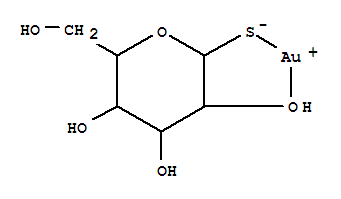
High Quality Chinese Factory supply 12192-57-3 Aurothioglucose
- Molecular Formula:C6H11 Au O5 S
- Molecular Weight:392.20
- Boiling Point:°Cat760mmHg
- Flash Point:°C
- PSA:115.45000
- Density:g/cm3
- LogP:-2.01870
Aurothioglucose(Cas 12192-57-3) Usage
|
History |
In 1927, aurothioglucose was found to relieve joint pain when used to treat bacterial endocarditis. The area of chrysotherapy had begun. Subsequent investigations led to an extensive study of gold compounds in Great Britain by the Empire Rheumatism Council, which reported in 1961 that sodium aurothiomalate was effective in slowing the development of progressive joint diseases. Both aurothioglucose and sodium aurothiomalate are orally ineffective and are administered by IM injection. In 1985, the first orally effective gold compound for arthritis, auranofin, was introduced in the United States. Several other gold compounds have been evaluated clinically but do not appear to offer advantages in terms of efficacy or toxicity. |
|
Biochem/physiol Actions |
Aurothioglucose, a gold compound used clinically to treat rheumatoid arthritis, has recently been found to be a potent PKCiota-Par6 interaction inhibitor, with an IC50 approximately 1 μM. Disruption of this interaction disrupts a rac1 signaling pathway that is required for transformed growth in non-small-cell lung cancer. |
|
Safety Profile |
Confirmed carcinogen with experimental carcinogenic and neoplastigenic data. A deadly human poison by an unspecified route. An experimental poison by intramuscular route. Moderately toxic by subcutaneous and intravenous routes. Human systemic effects: nausea or vomiting, cholestatic jaundlce, and eye effects. An experimental teratogen. Other experimental reproductive effects. See also GOLD COMPOUNDS. When heated to decomposition it emits very toxic fumes of SOx. Used to treat rheumatoid arthritis. |
|
Purification Methods |
Purify it by dissolving it in H2O (0.05g in 1mL) and precipitating it by adding EtOH. It yields yellow crystals with a slight mercaptan odour. It decomposes slowly in H2O, and is soluble in propylene glycol but insoluble in EtOH and other common organic solvents. [Caterson & Taylor FEBS Lett 98 351 1979, Cooney et al. Biochem J 259 651 1989.] |
|
Brand name |
Solganal (Schering). |
InChI:InChI=1/C6H12O5S.Au/c7-1-2-3(8)4(9)5(10)6(12)11-2;/h2-10,12H,1H2;/q;+1/p-1/t2-,3-,4+,5-,6-;/m1./s1/rC6H11AuO5S/c7-13-6-5(11)4(10)3(9)2(1-8)12-6/h2-6,8-11H,1H2/t2-,3-,4+,5-,6-/m1/s1